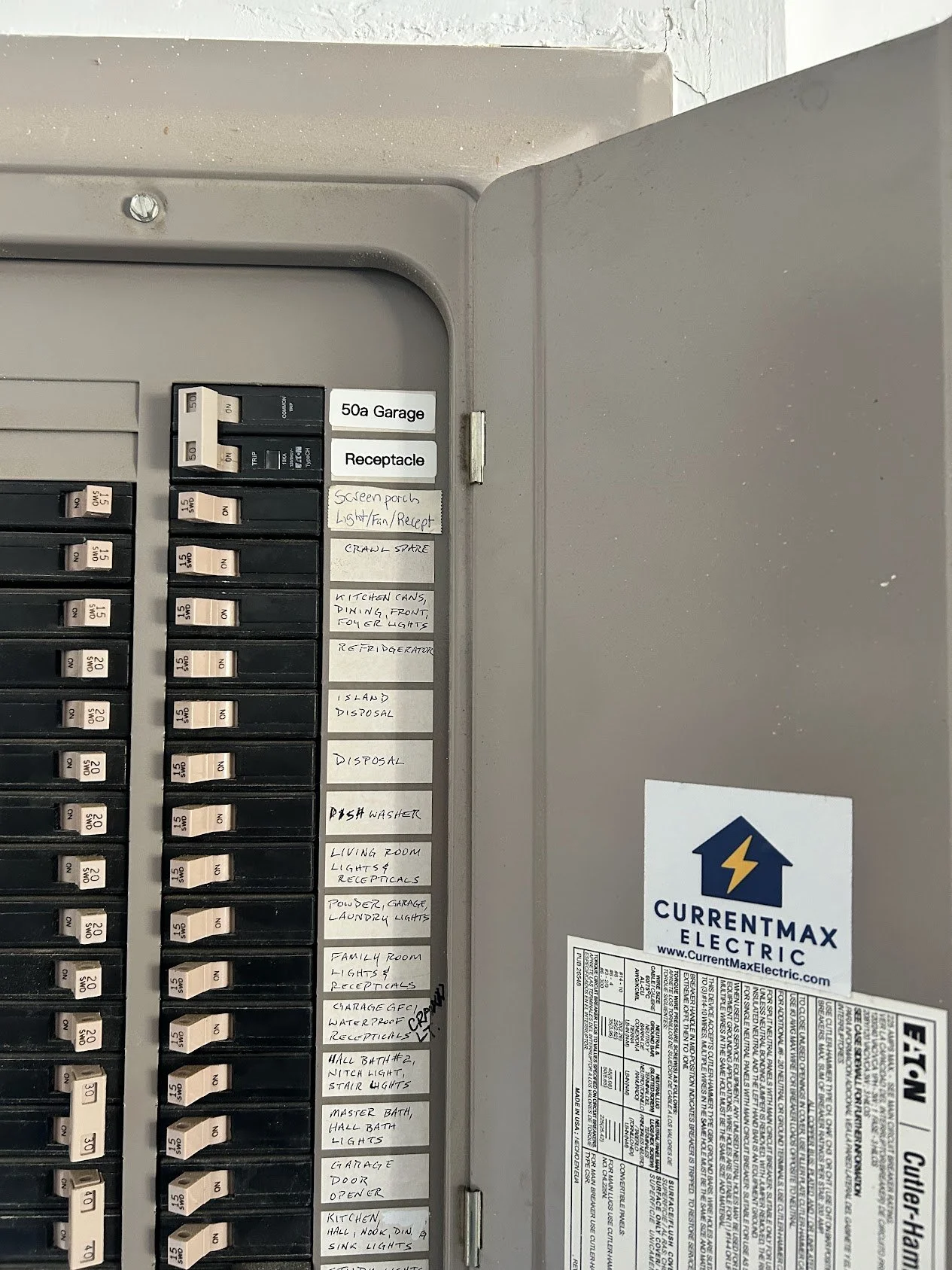
Electrical Panel & Service Upgrades
CurrentMax Electric delivers residential electrical panel upgrades, heavy-ups, and subpanel installations throughout your local service area. Our licensed and insured electricians modernize outdated 100-amp panels to 200-amp or 400-amp systems right at your home, ensuring your electrical infrastructure safely supports EV chargers, heat pumps, modern appliances, and whole-home surge protection.
Service Capabilities & Equipment
Whether you are expanding your home’s electrical capacity for high-draw appliances or replacing obsolete, hazardous equipment, we install industry-standard hardware engineered for safety and reliability:
Service Amperage Heavy-Ups: Upgrades from legacy 60A/100A services to standard 200A or high-demand 400A (320A continuous) split-meter configurations.
Premium Breaker Panels & Enclosures: Installation of Square D (QO & Homeline), Siemens, Eaton (Cutler-Hammer CH & BR), and Leviton Smart Panels.
Smart Panel & Energy Management Systems: Turnkey deployment of Span.io smart electrical panels and DCC (Demand Charge Controller / Energy Management) boxes for load-shedding without requiring full utility transformer upgrades.
Subpanel Additions: Dedicated 60A to 125A subpanels for detached garages, workshops, finished basements, and backyard suites.
Whole-Home Surge Protective Devices (SPDs): Type 1 and Type 2 surge protectors installed directly at the main disconnect to protect sensitive electronics, HVAC controllers, and smart systems.
Safety & Grounding System Retrofits: Upgrades to intersystem bonding termination, dual copper grounding electrode systems (driven 8-foot ground rods spaced 6 feet apart), and water pipe/gas line bonding.
Breaker Replacements & Modernization: Replacement of obsolete or discontinued panels (including Federal Pacific Electric/Stab-Lok, Zinsco, and older fuse boxes) with modern AFCI/GFCI dual-function breakers.
Local Permitting & NEC Code Compliance
Electrical heavy-ups involve both your local building department and your electric utility provider. We coordinate the entire process to ensure compliance with the National Electrical Code (NEC):
-
Every panel sizing decision is backed by comprehensive NEC Article 220 demand load calculations to prevent over-subscription of service-entrance conductors.
-
Under current NEC standards, all dwelling unit service replacements require an approved Type 1 or Type 2 Whole-Home Surge Protective Device (SPD) installed at the service entrance.
-
All residential service replacements require an accessible exterior emergency disconnect or meter-main combination so first responders can safely cut utility power from outside the home.
-
We install supplemental grounding rods with a minimum 6-foot separation and verify low-impedance bonding to cold-water mains and gas piping ahead of municipal inspection.
-
Panels are positioned with a minimum 30-inch wide, 36-inch deep clear working space and at least 6.5 feet of headroom, free of plumbing or storage obstructions.
Transparent Cost Factors
| Cost Variable | Lower Impact | Higher Impact |
|---|---|---|
| Existing Service Capacity | 100A to 200A swap on an existing overhead line | 100A/200A to 400A upgrade requiring dual-panel configurations or meter-base rebuilds |
| Service Line Entry | Overhead drop with adequate utility mast clearance | Underground lateral requiring trenching through paved surfaces, concrete slabs, or extensive landscaping |
| Meter and Panel Distance | Back-to-back installation (meter base directly opposite the panel) | Distant runs requiring long service-entrance conductor (SEC) runs through finished ceilings or crawlspaces |
| Condition of Grounding | Existing accessible ground wire and water-meter jump intact | Complete re-grounding required (installing dual ground rods, bonding CSST gas lines, or driving new grounding rings) |
| Wiring Condition and Circuit Count | Plentiful wire slack inside the existing panel cavity | Shortened branch conductors requiring junction boxes, extensive wire splices, or full circuit re-mapping |
Step-by-Step Installation Process
Site Assessment & Load Calculation
Pre-install technical review
We inspect your current panel, meter socket, and grounding path. We then calculate your home’s existing and projected electrical demand under NEC Article 220 to determine the exact panel sizing (200A vs. 400A) and identify utility coordination needs.
Permit Acquisition & Utility Coordination
Handling all regulatory paperwork
CurrentMax Electric submits detailed engineering plans and pulls required municipal permits. We coordinate scheduled service disconnects and reconnects directly with your electric utility company.
Installation & System Modernization
1-day scheduled power shutdown
Our technicians remove the obsolete enclosure, mount the new meter base and panelboard, install new main service-entrance conductors, wire dual-function AFCI/GFCI breakers, connect the whole-home surge protector, and establish all grounding electrode bonds. Power is typically restored by late afternoon.
Code Inspection, Testing & Final Sign-Off
Final sign-off and safety audit
We perform complete voltage drop and polarity testing across all circuits. The municipal inspector inspects the job site for final permit sign-off, after which the utility provider applies their security seal to the new meter enclosure.
Frequently Asked Questions
-
For a standard 100A to 200A panel replacement, power is disconnected in the morning when the utility de-energizes the drop, and we typically restore service the same afternoon—usually within 4 to 8 hours. We coordinate closely with the power company to minimize downtime.
-
If your home’s existing panel has no remaining physical breaker slots, your main breaker frequently trips during heavy appliance usage, or you plan to add high-power amenities like an Level 2 EV charger, heat pump system, induction range, or hot tub, you likely need a 200A service. Homes exceeding 3,500 square feet with multiple electric HVAC systems, dual EV chargers, or pool equipment often benefit from a 400A split service.
-
Yes. CurrentMax Electric installs Span.io smart panels as well as traditional panels equipped with smart energy management monitors (such as Emporia or Leviton Smart). Smart panels allow you to monitor branch-circuit energy consumption in real time and automatically shed non-essential loads during an outage or when operating on a residential battery backup system.
-
Modern safety standards (NEC Article 250) require dual driven grounding electrodes spaced at least 6 feet apart to protect your home from lightning strikes, grid transients, and utility line surges. Legacy homes often relied exclusively on metal water pipes, which lose effectiveness when municipalities or previous plumbers replace sections with non-conductive PEX or PVC piping.
-
Yes. Many insurance underwriters refuse coverage or charge higher premiums for homes with obsolete equipment such as Federal Pacific Electric (FPE) Stab-Lok, Zinsco, or fuse boxes due to documented fire risks. A modern 200A panel with whole-home surge protection satisfies home inspector audits and buyer contingencies.